
SmarTasty
Count calories with a photo
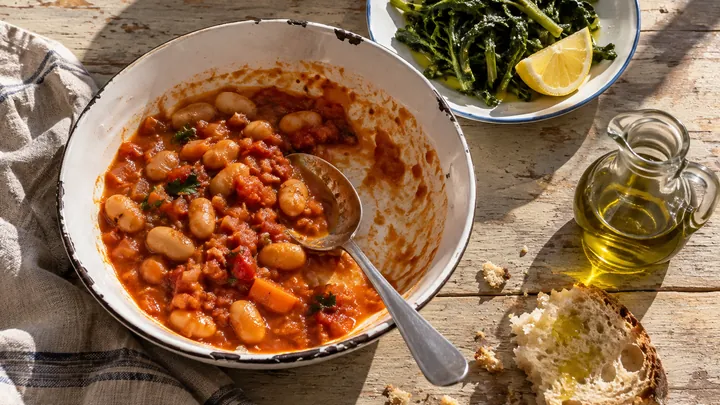
Our longevity score rates each recipe from 0 to 10 on how closely it follows the Blue Zones diet: points for beans, veg, wholegrains, nuts and fish.
The longevity score – shown on each recipe as “Blue Zones principle” – rates a recipe from 0 to 10 on how closely it matches the traditional Blue Zones diet. The Blue Zones are regions where an unusual number of people live to a very old age, such as Sardinia, Okinawa and Ikaria. There, beans, lentils or chickpeas were eaten almost every day, with plenty of vegetables, grains, nuts and olive oil. Meat was rare.
It works like the diet scores used in nutrition research, such as the Mediterranean diet score: points for food groups linked to healthier eating patterns, deductions for the ones that aren’t. Which groups count is based on Blue Zones cooking and on the dietary risks of the Global Burden of Disease study (The Lancet, 2019).
It scores a recipe, not you. It describes what’s in a dish – how long anyone lives depends on far more than food, let alone a single meal. For full recipes, see our Blue Zones-style recipes.
| What’s in the recipe | Points |
|---|---|
| Points added | |
| Beans & lentils – beans, lentils, chickpeas, peas, edamame, tofu, tempeh | +2 |
| Vegetables – +1 from 2 kinds, +2 from 4 kinds | up to +2 |
| Wholegrains – oats, wholewheat pasta, quinoa, brown rice, bulgur, millet | +1 |
| Fruit – whole fruit, avocado too – not juice, syrup or jam | +1 |
| Nuts or seeds – walnuts, almonds, flaxseed, sesame, tahini | +1 |
| Olive oil | +1 |
| Oily fish – salmon, mackerel, herring, sardines, trout, tuna | +1 |
| Doesn’t count | |
| Chicken, eggs & co. – turkey, dairy, potatoes, white flour, butter, white fish | 0 |
| Points taken off | |
| Processed meat – sausages, ham, salami, cold cuts – chicken or turkey too | −3 |
| Ready-made food – jar sauces, instant meals, packet soup, additives like MSG | −2 |
| Red meat – beef, lamb, veal – only counts when there’s no processed meat | −1 |
| Lots of salt – from 2.5 g per serving | −1 |
| Lots of sugar – from 20 g and over 20% of energy, honey and syrup included | −1 |
Each group counts once. Anything above 10 stays 10, below 0 stays 0.
Blue Zones-style recipes: From 7, plus a key ingredient: beans or lentils, oily fish, walnuts, flaxseed or something fermented.
Most of the 3,570 recipes in our collection score 5 or 6. Just over a third reach 7 or more.
| Score | Recipes |
|---|---|
| 0 | 0 |
| 1 | 4 |
| 2 | 13 |
| 3 | 37 |
| 4 | 281 |
| 5 | 847 |
| 6 | 1109 |
| 7 | 664 |
| 8 | 348 |
| 9 | 201 |
| 10 | 66 |
As of October 2026, 3,570 recipes. Highlighted: 7 and above, 36% together.
Here’s how the score moves when you cook the same dish differently.
| Recipe | What counts | Score |
|---|---|---|
| Classic bolognese with soft rice noodles | Beef mince −1 · 3 veg +1 · Olive oil +1 | 5 |
| Wholewheat spaghetti bolognese | Beef mince −1 · 6 veg +2 · Wholegrain +1 · Olive oil +1 | 7 |
| High-protein bolognese with beef and lentils | Beef mince −1 · Lentils +2 · 4 veg +2 · Olive oil +1 | 8 |
| Vegan red lentil bolognese with wholewheat pasta | Lentils +2 · Wholegrain +1 · 4 veg +2 · Olive oil +1 | 10 |
The biggest step: add beans or lentils. Lentils in the sauce add 2 points, even if the mince stays.
Every region cooks differently. What they share: mostly plants, beans almost every day, little meat and hardly anything ready-made.
| Region | Typical foods |
|---|---|
| Okinawa (Japan) | sweet potatoes, tofu and miso, vegetables, seaweed, some fish |
| Sardinia (Italy) | beans and minestrone, barley, sourdough bread, vegetables, sheep’s cheese |
| Ikaria (Greece) | beans, chickpeas, wild greens, potatoes, olive oil, herbal tea |
| Nicoya (Costa Rica) | corn tortillas, black beans, squash, rice, tropical fruit |
| Loma Linda (USA) | vegetarian Adventist cooking: beans and lentils, nuts, wholegrains, vegetables |
Demographers have verified the first four. Loma Linda is often included but doesn’t meet the same criteria. Cook the pattern with our Blue Zones-style recipes.
Almost everything we know about food and longevity comes from observational studies and models. They show links over many years, not the effect of a single dish.
| Study | What it found | How strong |
|---|---|---|
| Global Burden of Disease (The Lancet, 2019) | About 11 million deaths worldwide in 2017 were attributed to dietary risks. Top of the list: too much salt, too few wholegrains, too little fruit. | Model based on observational data |
| Mediterranean diet score (NEJM, 2003) | In Greece, a score 2 points higher went along with a quarter lower mortality. Single foods showed little on their own – the overall pattern did. | Observational, 22,043 people |
| Legumes in older age (2004) | In people over 70 in four countries, every extra 20 g of beans or lentils a day went along with 7–8% lower mortality. | Observational, 785 people |
| Modelling study (PLOS Medicine, 2022) | Beans and lentils, wholegrains and nuts made up the largest share in the model. | Population estimate, not a prediction for any one person |
| PREDIMED (NEJM, 2018) | A Mediterranean diet with olive oil or nuts: fewer major cardiovascular events than a low-fat comparison diet. | Randomised, 7,447 people at high risk; lifespan wasn’t the outcome |
| WHO cancer agency (IARC, 2015) | Processed meat is classed as carcinogenic (Group 1), red meat as probably carcinogenic (Group 2A). | The group shows how certain the evidence is, not how big the risk is |
Every recipe starts at 4. Each group counts once, however much is in it: a tablespoon of sesame counts as much as a handful of walnuts. Tiny amounts up to 10 g of beans, wholegrains, vegetables or fruit don’t count.
Beans and lentils add the most because they were on the table almost daily in every Blue Zone and made up the largest share in modelling studies. Processed meat takes the most off because the WHO classes it more strictly than red meat. Red meat only counts when there’s no processed meat.
Salt from 2.5 g per serving is half the WHO limit of 5 g a day. For sugar, honey, maple syrup and coconut sugar count too, as in the WHO guideline.
A single recipe doesn’t decide how long anyone lives – what counts is how you eat over the long run.
The score follows fixed rules, the same for every recipe. It doesn’t replace medical or dietary advice.
A score from 0 to 10 that shows how closely a recipe matches the Blue Zones way of eating. Beans and lentils, vegetables, wholegrains, fruit, nuts, olive oil and oily fish add points; processed meat, ready-made food, red meat, lots of salt and lots of sugar take points off. It describes the recipe, not your life expectancy.
Regions where researchers counted an unusually high number of verified centenarians: Okinawa (Japan), Sardinia (Italy), Ikaria (Greece) and the Nicoya Peninsula (Costa Rica). Loma Linda (USA) is often added. The term comes from a 2004 study of Sardinia and was popularised by journalist Dan Buettner.
Mostly plants: beans, lentils, chickpeas or soya almost every day, plus vegetables, grains, root vegetables, nuts and – around the Mediterranean – olive oil. Meat was eaten rarely and in small amounts, and ready-made food hardly at all.
It’s debated. Demographer Saul Newman argues that many record ages come from registry errors or pension fraud – so far only in a preprint that hasn’t been peer-reviewed. Blue Zones researchers point to checks against birth, church and family records. For the score it matters less: the foods it counts are well studied in large populations outside the Blue Zones too.
No. The “Longevity Diet” is a specific plan by researcher Valter Longo that includes fasting periods. The Blue Zones diet describes how people traditionally ate in a few long-lived regions. Our score only measures how close a recipe is to that traditional cooking.
Beans, lentils and chickpeas were eaten almost every day in every Blue Zone. In a study of older people in four countries they were the food with the clearest link, and in modelling studies they made up the largest share.
Yes. Sausages, ham and cold cuts made from chicken or turkey are processed meat and take 3 points off, just like beef salami. Plain chicken or turkey is neutral.
They’re neutral. They were part of Blue Zones cooking, but not the centre of the plate. The score only counts what defines that cooking or what large studies clearly name as a risk.