With your consent, we use Google Analytics to improve SmarTasty. Data may be transferred to the USA. You can withdraw at any time. · Privacy
Eating healthier: how to start
AI image
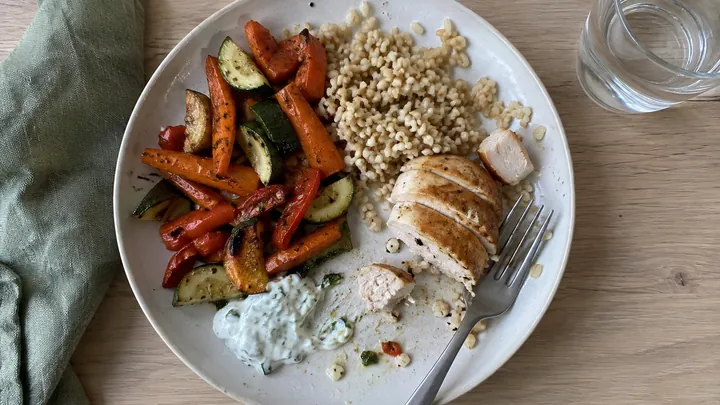
Eat healthier without a diet or counting: one change at a time, a plate with veg, protein and wholegrains, water as your main drink and simple meals.
1 change at a time – make it a habit, then add the next
½ plate of veg – plus a quarter protein and a quarter wholegrains
0 counting needed – see how balanced your food is without tracking calories
No plan, no bans, no counting: here are seven steps to eat healthier day to day – one after the other. Plus how to see where you stand, and what you can skip.
Why one change at a time is enough
Changing everything at once in January rarely lasts. It’s easier to pick one small change and repeat it until you no longer think about it. Then add the next.
How long that takes varies. In one study, a new habit became automatic after 66 days on average – between 18 and more than 250 days depending on the person. Missing a single day made little difference (Lally et al. 2010).
7 steps to eating healthier
Look at how you eat first. Log what you eat for a few days without changing anything. You’ll see where things are easy: maybe lunch has no veg, maybe you don’t drink much.
Build your plate. Half veg or salad, a quarter protein (pulses, fish, eggs, yoghurt, tofu or meat), a quarter wholegrains or potatoes. Add some good fat such as olive oil or nuts.
Eat more plants. The German Nutrition Society (DGE) recommends at least five portions of fruit and veg a day. Add pulses, nuts, seeds and herbs. A goal that’s fun: 30 plants a week.
Choose wholegrains more often. Wholegrain bread, oats, brown rice, wholewheat pasta. One swap a week is enough.
Make water your main drink. The DGE suggests around 1.5 litres a day, ideally water. Unsweetened tea counts too. Fizzy drinks and juice are the exception.
Eat less ultra-processed food. Have ready meals, crisps, sweets and sweetened drinks less often. The ingredients list helps: the shorter and more familiar, the better the fit. More in ultra-processed food.
Cook simple meals yourself. Roasted veg with chickpeas, a lentil soup, pasta with lots of veg. Cook an extra portion and tomorrow’s lunch is sorted.
What you can skip
Strict regimes: a few hard weeks do less than a plate you enjoy every day.
Powders and capsules: they don’t replace veg.
Perfection: a slice of cake on Sunday doesn’t undo anything. What you eat most of the time counts.
Counting if you don’t want to: eating healthier works without tracking calories.
If an approach built on minimally processed food appeals to you, read on in clean eating.
See where you stand
SmarTasty’s Health Score shows from 0 to 100 how balanced a recipe, a meal or your whole day is, using fixed rules based on ingredients and nutritional values. It describes your food, not your health.
If you choose “Eat well” when you set up the app, you see how balanced your food is – no counting. You can also pick up to three nutrients to keep an eye on: fibre, iron, calcium, magnesium, vitamin D or protein.
Log first, plan later. The app only suggests the Meal Planner once you’ve collected three recipes of your own or logged food on five days. That way you plan with dishes you actually eat.
A day to try
Breakfast: porridge with natural yoghurt, apple and walnuts.
Lunch: lentil soup with carrots and a slice of wholegrain bread.
Snack: veg sticks with hummus.
Dinner: roasted veg with chickpeas, feta and herb yoghurt.
With one change, not ten. For example, a portion of veg with lunch every day, or water instead of fizzy drinks. Once that sticks, add the next.
Do I have to count calories?
No. A plate with plenty of veg, protein and wholegrains, plus water as your drink, gets you a long way. Counting is an option, not a must.
What’s the easiest first step?
Log what you eat for a few days without changing anything. Then you’ll see where a small change is easiest.
Is eating healthier expensive?
Not necessarily. Oats, lentils, beans, eggs, potatoes, cabbage and frozen veg cost little. Ready meals and powders are the pricey part.
Can I still eat sweet things?
Yes. What you eat most of the time counts. If you like something sweet, fruit, dates or a little honey are a good choice.
How long does it take for healthier eating to become a habit?
It varies. In one study, a new habit became automatic after 66 days on average – for some after 18 days, for others after more than 250. Missing a single day made little difference.
Lally P, van Jaarsveld CHM, Potts HWW, Wardle J (2010): How are habits formed: modelling habit formation in the real world. European Journal of Social Psychology. https://doi.org/10.1002/ejsp.674