
SmarTasty
Count calories with a photo
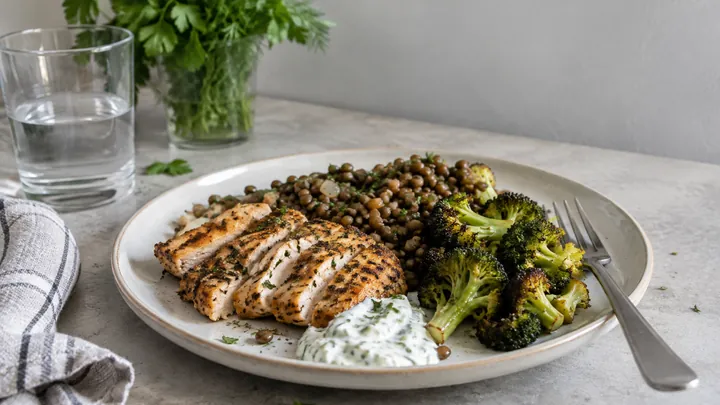
Adults need 0.8 g of protein per kg of body weight a day, 1.0 g from 65 (DGE). If you train, plan with 1.4 to 2.0 g. Foods and an example day.
“High protein” is on lots of packets these days. You rarely need special products for it, though – quark, eggs, fish, pulses and tofu do the job. Here’s how much protein you need, where it comes from and what a high-protein day looks like in numbers.
Proteins are building materials: muscles, skin, hair, connective tissue, enzymes and antibodies are made of them. Their building blocks are called amino acids. Nine of them are essential – your body can’t make them itself, so they have to come from food.
The DGE gives 0.8 g of protein per kg of body weight a day for adults, and 1.0 g from 65. That’s a baseline for covering your needs, not a target for training or a calorie deficit. According to the DGE, recreational sport doesn’t raise it.
For people who train regularly, the International Society of Sports Nutrition (ISSN, 2017) gives 1.4 to 2.0 g per kg. In an analysis of 49 studies on strength training, more than about 1.6 g brought no extra gain in muscle mass on average; the upper limit was 2.2 g (Morton 2018).
| Your goal | Protein per kg | Why this amount |
|---|---|---|
| Eat well | 1.4 g | More than the DGE baseline, at the lower end of the ISSN range for active people. |
| Eat lighter | 2.0 g | Studies of calorie-reduced diets name 1.2 to 1.6 g (Leidy 2015). 2.0 g is at the upper end of the ISSN range and below the 2.2 g limit from the strength-training analysis (Morton 2018). |
| Build muscle | 2.0 g | Within the ISSN range for people who train. |
Work out your own amount with the protein calculator.
If you have kidney disease, agree your protein intake with your doctor.
You don’t need chicken breast. Both kinds of protein have pros and cons. Biological value describes how well a protein from food can be turned into your body’s own protein.
A day with around 140 g of protein – for example at 70 kg with the goal “build muscle” (2.0 g per kg):
Tip: plan a protein source into every meal. Good snacks: edamame, skyr or a handful of nuts.
For a whole week to cook, with calories and protein, see the high-protein meal plan.
High-protein recipes: recipes for every day
The German Nutrition Society (DGE) gives 0.8 g per kg of body weight for adults and 1.0 g from 65. That’s the baseline – according to the DGE, recreational sport doesn’t raise it. For people who train regularly, the International Society of Sports Nutrition gives 1.4 to 2.0 g per kg. SmarTasty uses 1.4 g (eat well) or 2.0 g (eat lighter, build muscle), depending on your goal.
No. The DGE value covers the needs of almost all adults and still applies (derived in 2017). It isn’t a target for training or a calorie deficit, though – for that, professional bodies give higher amounts.
For people without kidney problems, a higher protein intake is considered unproblematic. If you have kidney disease, always agree the amount of protein with your doctor.
Yes. If you combine different plant sources such as grains and pulses over the day and eat enough protein overall, you can build muscle on plants too.