
SmarTasty
Count calories with a photo
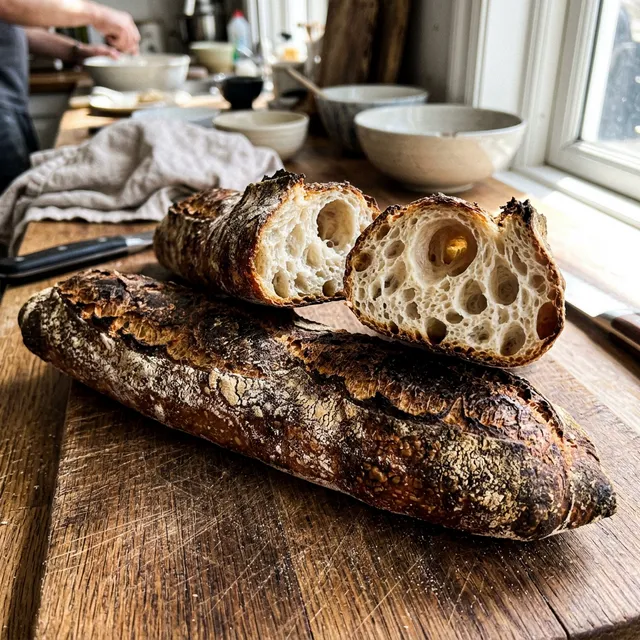
Vegan sourdough baguette with liquid sourdough starter, baguette flour and sea salt: a crisp crust, an open crumb and a long fermentation for lots of flavour.
You’ll need: oven · baking tray · chopping board · knife · mixing bowl
A good baguette mainly needs time and patience. You can taste that here: a robust crust, a moist crumb and an honest smell from the oven.
Baguette flour → plain flour (similar baking properties). Baguette flour → spelt flour (also provides minerals). Part of the baguette flour → wholemeal flour (also provides fibre). Sea salt → rock salt (comparable function in the dough).
Contains gluten from wheat, so it's unsuitable for people with coeliac disease; for children and in pregnancy, it's usually fine as a fully baked bread.
Baguette flour mainly provides starch, plus some plant protein and, depending on the type of flour, small amounts of B vitamins and minerals such as iron and magnesium. Paler flour usually contains less of these than flour with a higher extraction rate.
Yes – fermentation produces organic acids and aroma compounds. Some flour components can also be broken down, which changes the composition of the dough slightly.
Some people find long-fermented sourdough more pleasant. But that's not a fixed rule, because how well bread agrees with you depends a lot on your personal sensitivity, the proving time and the flour.
Sea salt mainly provides sodium and, besides flavour, also affects the stability of the dough. Nutritionally, it usually differs only slightly from ordinary salt.
With classic baguette flour, the fibre content is fairly moderate, as it's usually a pale, finely milled flour. If you're after more fibre, swapping in some wholemeal flour would be the obvious option.