With your consent, we use Google Analytics to improve SmarTasty. Data may be transferred to the USA. You can withdraw at any time. · Privacy
Vegan rosemary and olive focaccia (sourdough)
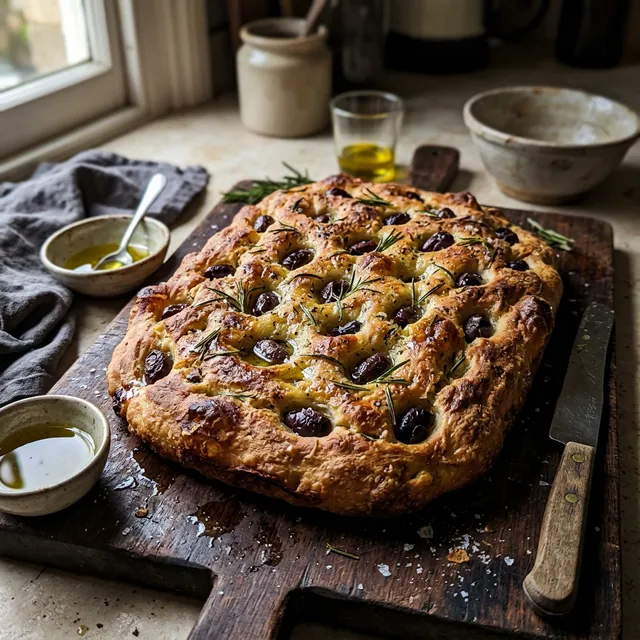
Vegan rosemary and olive focaccia with sourdough, Kalamata olives, extra virgin olive oil and fresh rosemary.
At a glance
Serves 10
Prep time: 300 min
Cooking time: 25 min
Total time: 325 min
Calories: 240 kcal per serving
Protein: 5 g
Fat: 7 g
Carbs: 38 g
Ingredients
100 g active sourdough starter
400 g plain flour
100 g wholemeal spelt flour
50g black Kalamata olives
350ml lukewarm tap water
12g sea salt
50ml extra virgin olive oil
2 sprigs of fresh rosemary
Method
You’ll need: oven
Dissolve the active sourdough starter in the lukewarm water and roughly mix in the flours until there's no dry flour left. Leave the dough to rest briefly.
Work in the sea salt and a little olive oil and knead the dough until it gets smoother. Then stretch and fold the dough over several rounds.
Leave the dough to rise somewhere warm until it has visibly risen and shows fine bubbles. Grease a tin with olive oil, add the dough and spread it out carefully.
Leave the dough to rest again so it becomes airy. Then drizzle with olive oil and press the typical dimples into it with your fingers.
Press the Kalamata olives and fresh rosemary into the dimples, sprinkle with a little coarse sea salt and bake at 220 °C (200 °C fan) for 20–25 min, until the focaccia is golden brown.
Leave to cool briefly and serve, ideally lukewarm. A green salad or a white bean dip goes well with it.
Good to know
This focaccia is simple, and that's exactly why it's so good. The sourdough adds depth, the crumb stays soft and the edge gets lovely and crisp.
Swaps
Kalamata olives → green olives (similar fats, slightly milder flavour); rosemary → thyme (also provides aromatic plant compounds); extra virgin olive oil → avocado oil (heat-stable, mainly monounsaturated fats); coarse sea salt → herb salt without additives (more flavour, often a little less salt needed)
Allergens
Contains gluten, so it isn't suitable for people with coeliac disease. Usually fine for children, but in smaller portions because of the salt; no concerns in pregnancy if the focaccia is baked right through.
Frequently asked questions
What's in Kalamata olives nutritionally?
Kalamata olives mainly provide monounsaturated fats, including oleic acid, plus some vitamin E and polyphenols. Depending on how they're processed, they can also be fairly salty.
Is extra virgin olive oil still interesting nutritionally when baked?
Some of the heat-sensitive plant compounds decrease during baking, but the fat composition still matters. Extra virgin olive oil mainly brings oleic acid and, depending on quality, measurable amounts of polyphenols.
Does rosemary make any nutritional difference in such a small amount?
Rosemary contains essential oils and antioxidant plant compounds. In a focaccia, though, the amount matters more for cooking than for nutrition.
What happens to sourdough during fermentation?
During the long fermentation, microorganisms change certain carbohydrates and dough structures.
Is the salt content an issue with olive focaccia?
Yes, because both the sea salt and the olives provide sodium. If you're watching your salt, go easy on the extra salt on top.