
SmarTasty
Count calories with a photo
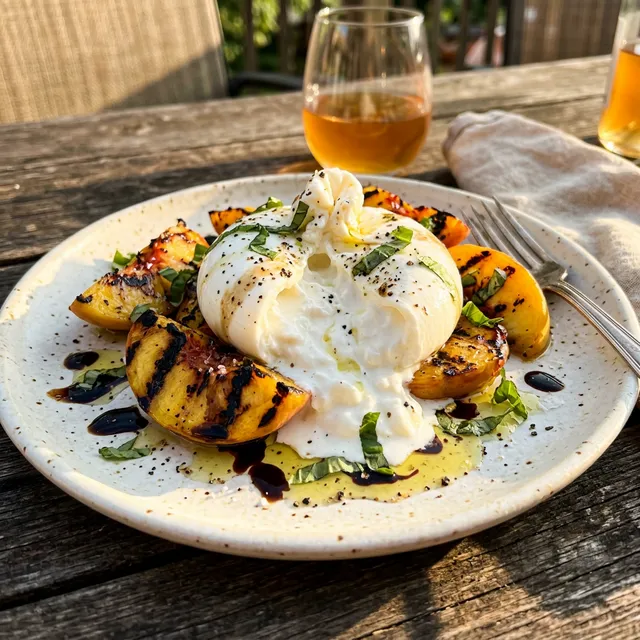
Low-carb burrata with roasted peaches and basil: creamy burrata, sweet peaches, basil, pine nuts and balsamic vinegar on one quick, summery plate.
You’ll need: griddle pan · chopping board · knife
Some plates don't need much to feel special. Here warm meets creamy and sweet meets savoury – and that's exactly what makes it so lovely.
Peaches → apricots (a little less sugar, similarly aromatic) Pine nuts → walnuts (more omega-3 fatty acids, more satisfying) Balsamic vinegar → lemon juice (less sugar, fresher flavour) Burrata → buffalo mozzarella or skyr (less saturated fat, more protein depending on your choice)
Contains milk and pine nuts. Usually fine for children, but not suitable for anyone with a nut or seed allergy; during pregnancy, pasteurised burrata is the safe choice.
Burrata mainly provides protein, calcium and vitamin B12. Depending on how it's made, it also contains a fair share of saturated fat.
Peaches contain vitamin C, some beta-carotene and various polyphenols. Their fibre content is fairly moderate but adds to the dish as a whole.
Yes, basil contains vitamin K plus small amounts of essential oils and polyphenols, among others. The amount you eat is usually small, so its nutritional contribution stays modest.
Pine nuts provide unsaturated fatty acids and magnesium. If you have a nut or seed allergy, though, they can be a problem.
Not necessarily – acetic acid can irritate the stomach or trigger reflux in some people. If you react to it, simply use a little less.