
SmarTasty
Count calories with a photo
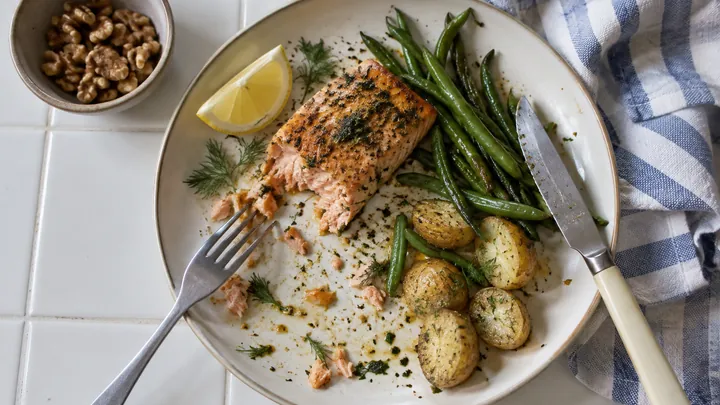
Our omega-3 & veg score counts omega-3 fats, vegetables, berries, spices, pulses and olive oil in a recipe – and takes points off for processed meat.
The omega-3 & veg score – shown on each recipe as “Omega-3 & veg” – counts how much omega-3, veg, berries, pulses, olive oil and spices a recipe contains. Processed meat, fried food, white flour and lots of sugar take points off.
Omega-3 comes from the nutrition values, everything else from the ingredient list. Oily fish, linseed, chia and walnuts bring omega-3 – more on the different fats in omega-3 vs omega-6.
| What’s in the recipe | Points |
|---|---|
| Points added | |
| Omega-3 – +1 from 0.3 g, +2 from 0.8 g, +3 from 1.5 g | up to +3 |
| Berries, cocoa, tea – +1, from two kinds +2 | up to +2 |
| Vegetables – leafy greens or cabbage +1, four kinds +1 | up to +2 |
| Pulses, olive oil, nuts – nuts and seeds from 10 g | +1 each |
| Spices, fibre – turmeric, ginger, cinnamon · from 8 g fibre | +1 each |
| Points taken off | |
| Processed meat, trans fats – sausages, cold cuts, hydrogenated fats | −2 each |
| Sugar, white flour, seed oils – lots of added sugar (honey too), white flour, omega-6 oils | −1 each |
| Fat and heat – lots of saturated fat · fried or seared food | −1 each |
Each factor counts once. Maximum 10 points. Counts 20% towards the Health Score.
Every recipe starts at 4, and each factor counts once. Omega-3 comes from the nutrition values, the rest from the ingredient list.
Lots of saturated fat means from 8 g and over 12% of energy. Lots of added sugar: from 20 g and over 20% of energy.
Dairy doesn’t take anything off.
A recipe isn’t medicine – the score only describes its ingredients.
The score follows fixed rules, the same for every recipe. It doesn’t replace medical or dietary advice.
From a research index that rates dietary components based on almost 2,000 studies (Shivappa et al., 2014). We use the components you can see in a recipe: omega-3 fats, vegetables, berries, spices, pulses and olive oil score well there; processed meat, trans fats and lots of sugar don’t.
Oily fish such as salmon, mackerel, herring and sardines, plus linseed, chia seeds and walnuts. From 0.3 g per serving a recipe gets its first omega-3 point, from 1.5 g all three.